|
|
| home | exhibitions | interviews | features | profiles | webprojects | archive |
|
Making Waves - Representational Artists in St Ives 1930-1960 David Tovey
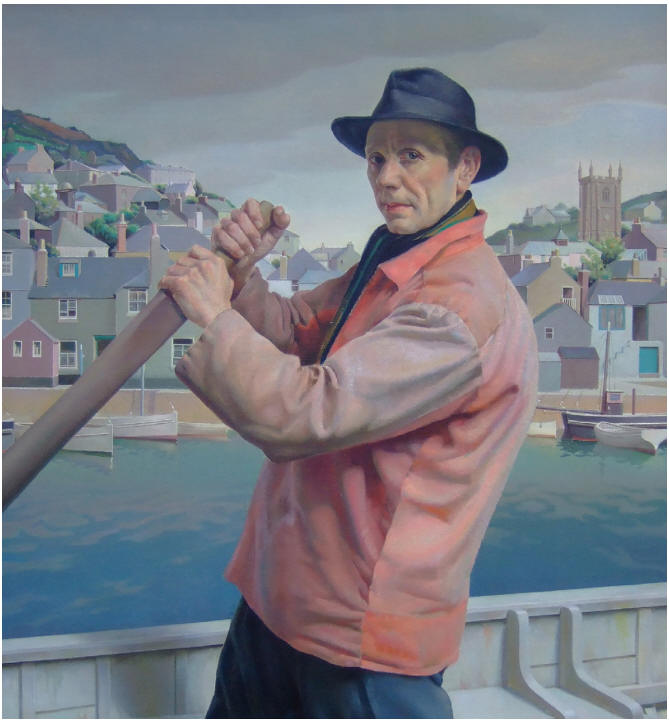
The 2026 exhibition at St Ives Museum, which will run as usual from the beginning of April to the end of October and is entitled Making Waves - Representational Artists in St Ives 1930-1960, is the fourth and last in the series of chronological surveys of St Ives art that I have curated there. Once again, it draws largely on my own collection but this time, in addition to a couple of works from other private collections, there are also paintings which St Ives Arts Club and St Ives Town Council have kindly agreed to lend. The title makes clear that the show does not attempt to feature the St Ives modernists, who came to the fore at the end of this period which witnessed the heyday of the St Ives Society of Artists (“STISA”), formed in 1927. With membership open to any artist who had ever worked in Cornwall, more than a dozen Royal Academicians were involved with STISA, including Julius Olsson, Terrick Williams, Stanhope Forbes, John Lamorna Birch, Laura Knight, Dod Procter, Stanley Spencer and Sir Frank Brangwyn. Due to the indefatigable enthusiasm of Robert Borlase Smart, STISA’s Secretary, touring shows were organised around the country and, between 1931 and 1949, over 20 public galleries hosted exhibitions by STISA, several more than once. This brought St Ives art to a wider public than ever before - one of two shows in 1936 attracting over 75,000 visitors. In 1947, Smart even managed to arrange a touring show to South Africa to accompany the King’s visit there. St Ives art really did make waves during this period. It was an extraordinary achievement. This exhibition concentrates predominantly on the St Ives resident artists whose contemporary style found favour with many of the public galleries that hosted these touring shows so that examples of their work were acquired for their permanent collections. These include artists such as Moffat Lindner, Borlase Smart, John Park, Arthur Hayward (see painting below 'The Boat Man (1939)), Dorothea Sharp, George Bradshaw, Bernard Ninnes, Thomas Maidment, Leonard Richmond, Leonard Fuller, Marcella Smith and others. A number of these artists would now be classified under the banner ‘British Impressionists’, working in a looser, more colourful style than pre-WW1 St Ives artists and not unnaturally St Ives’ sea views and its special light continued to inspire so that a number of St Ives artists were founder members of the Society of Marine Artists in 1939. However, the 1930s saw an increased interest in decorative arrangements and compositions, whilst the flat colour and the simplified design of the burgeoning poster market also had an influence.
Several STISA artists specialised in still life painting, with both Leonard Richmond and Marcella Smith writing books on the subject - the former including examples of the work of fellow STISA members John Park, Dod Procter and Helen Stuart Weir. The latter, like Dorothea Sharp and Marcella Smith, was a leading light in the Society of Women Artists, being recognised as one of the country’s foremost specialists in this genre. She is represented in the exhibition by her unusual still life from 1939 featuring a Top Hat, formerly owned by Hyman Segal. Another unusual still life featured is Shearer Armstrong’s Conversation Piece (Flowers with Birds), an example of the exotic decorative arrangements that she produced in the 1930s. This is one of the works lent by St Ives Arts Club, along with the exquisite Crabbers, St Ives Bay by Moffat Lindner.
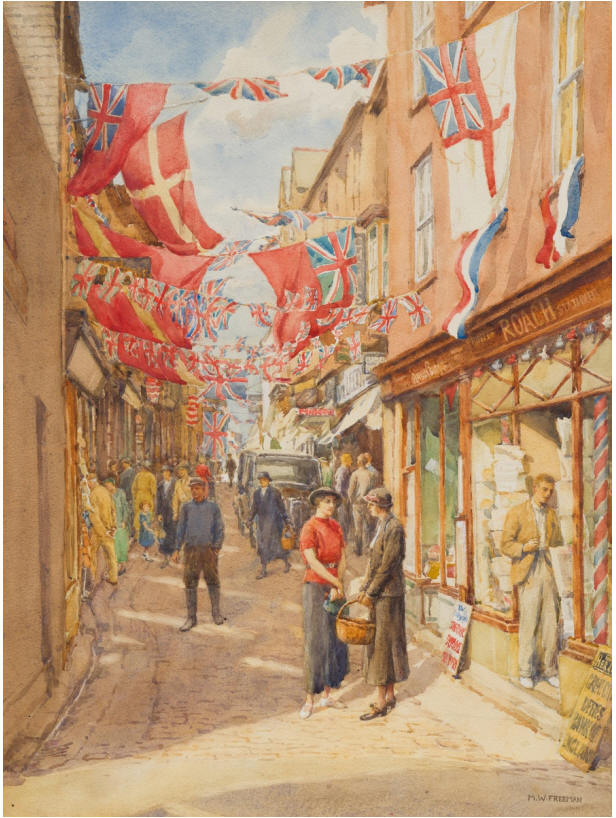
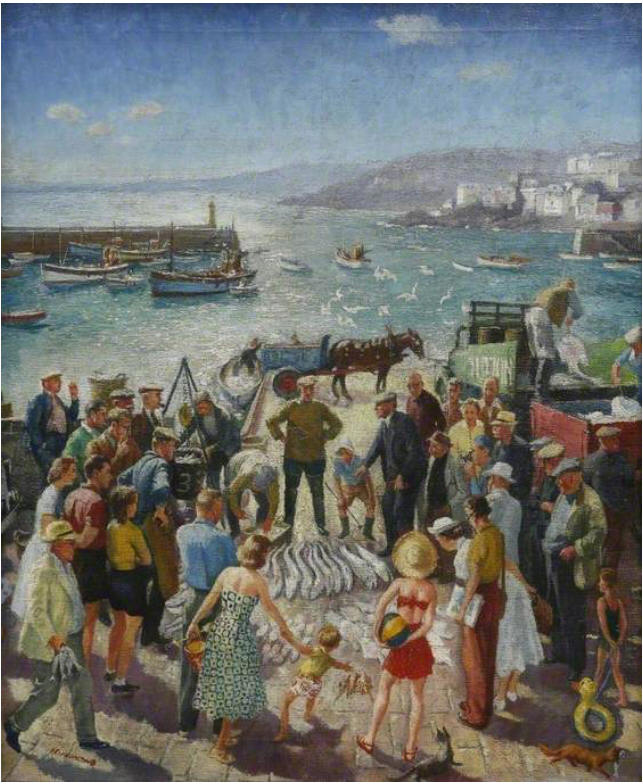
Works loaned by St Ives Town Council are paintings by Borlase Smart, Winifred Freeman, Dorothy Bayley and William Narraway and an unusual embroidery, Winter Morning Activities, St Ives by Alice Moore, who was not able to exhibit with STISA as her productions were considered craftwork.
Winifred Freeman’s painting (above) shows Fore Street gaily decorated for King George VI’s Jubilee in 1935. The local paper recorded, “The run on flags was phenomenal. Streamers and festoons spanned the streets, and in the twinkling of an eye, St Ives was transformed into a town glittering like a jewel....The cars of the townspeople and visitors gaily decorated with emblematical ribbons, and shops and house windows with portraits of our King and Queen were all eloquent testimonies to a prodigious wave of unbounded loyalty to King and Country. It was good to feel the aura of joyfulness and thanksgiving reaching from everyone and everything. In fact it was good to be alive in this Jubilee time.” The painting was one of the first acquired for the new Guildhall.
New research reveals that Narraway’s delightfully busy Fish sale scene (below) had been used for the front cover of the magazine John Bull on 19th September 1953 and had been donated to the Council by Odham’s Press, the magazine’s publisher. It transpired that the Museum already had a copy of this on display as the scene featured the cobbler, Richard Stevens (known as Dick Shoe), whose stitching machine is owned by the Museum.
Dorothy Bayley’s painting, Dutch Boat, Hayle, was one of several bought by the Council from STISA’s 1951 Festival of Britain exhibition. Other works so acquired were Bernard Ninnes’ A Cornish Hamlet - Nancledra, a typical Thomas Maidment of old St Ives and Wharton Lang’s sculpture of a tern. WW2 saw a major change in personnel in the colony, with a number of new artists arriving as St Ives was perceived as a safe haven. These included Ben Nicholson, Barbara Hepworth and Naum Gabo, who inspired a younger cross section of artists to experiment with non-representational work. This led to increased attention being given to the work of naive painter, Alfred Wallis. Whilst Borlase Smart had referred to modern art as “the cult of the ugly” in 1932, he was persuaded in 1944, following discussions with young art student, Wilhelmina Barns-Graham, to invite Ben Nicholson and Barbara Hepworth and other artists with modernist leanings to join STISA and they contributed to STISA’s major exhibition at the National Museum of Wales, Cardiff in 1947 and the touring show to South Africa that year. Some of the younger moderns, such as local boy Peter Lanyon, John Wells, Bryan Wynter and Sven Berlin, dissatisfied with the way their work was shown at STISA exhibitions, staged their own show in the Crypt of the Mariner’s Gallery in September 1946 and it was opened by Borlase Smart, much to the annoyance of Harry Rountree who wrote “what a pitiful racket this alleged art is” and accused Smart of “hunting with the hounds and running with the hare”.
After Smart’s death in November 1947, Falmouth-born David Cox succeeded him as Secretary of STISA. He too opened and reviewed shows by the Crypt Group (now including Barns-Graham) and led the group of artists who raised funds towards the purchase of the Porthmeor Studios from Moffat Lindner. He was also encouraged by the Nicholson/Hepworth camp to introduce a rule that meant that an artist member no longer had a right to be hung at every exhibition. Whilst no-one objected greatly to the principle behind this - that an exhibition’s impact should not be reduced by poor quality submissions - the rule was used to exclude certain traditionalist artists and, in particular, those deemed ‘commercial’ artists such as Rountree. His exclusion from the Swindon exhibition in January 1949 led him to comment “A highly accomplished artist might have a picture rejected and, on going to the gallery, be confronted by a picture of what looked like a diseased snake.” At the Extraordinary General Meeting called in February 1949, George Bradshaw spoke for the traditionalists and reputedly lost his temper, waving his fist uncomfortably close to the chin of the Chairman, Leonard Fuller, who he felt had let David Cox have too free a rein in drawing up / applying the new rule.
Egged on by Hepworth, who refused to join the newly elected Committee and who, as confirmed by Barns-Graham and Sven Berlin, was intent on engineering a split, demands were made that Cox resign, which he eventually duly did, followed by Fuller and many others. Whilst these artists became founder members of the Penwith Society, there were soon bust-ups there, as Nicholson and Hepworth sought to ensure the new Society focussed on non-representational art. Peter Lanyon, David Cox and Sven Berlin were some of the first to resign and Leonard Fuller, Marjorie Mostyn, Dorothy Bayley, Hyman Segal, Marion Hocken, Misome Peile and Isobel Heath soon rejoined STISA.
Both Societies made a special effort for the Festival of Britain exhibitions in 1951 and St Ives Town Council bought works from both shows for its collection. In fact, the publicity resulting from the 1949 bust-up meant that STISA’s sales in the early 1950s were the best ever (e.g. 1950 STISA £3,362, Penwith £417 ; 1951 STISA £3,300, Penwith £476). However, grant-giving bodies and the media in the 1950s were distinctly hostile to representational art and a number of artists who had made considerable waves in the 1930s and 1940s found the art market very difficult by the end of the decade, whilst the moderns went on to achieve national and international reputations. Since that time, representational art from this period has largely been neglected and often unfairly disparaged. It is hoped that the exhibition can raise greater awareness of the achievements of this group of artists.
David Tovey will be giving a lecture at Porthmeor Studios on Friday 12th June at 6.30 p.m. in which he will celebrate the careers of the St Ives resident members of STISA and place the works included in the exhibition into a wider context. David Tovey's website is here www.stivesart.info. Also see https://www.artcornwall.org/features_/David_Tovey/Discovering_St_Ives.htm 4.6.26 |
|
|